MCP Is Becoming the API Layer for AI Agents
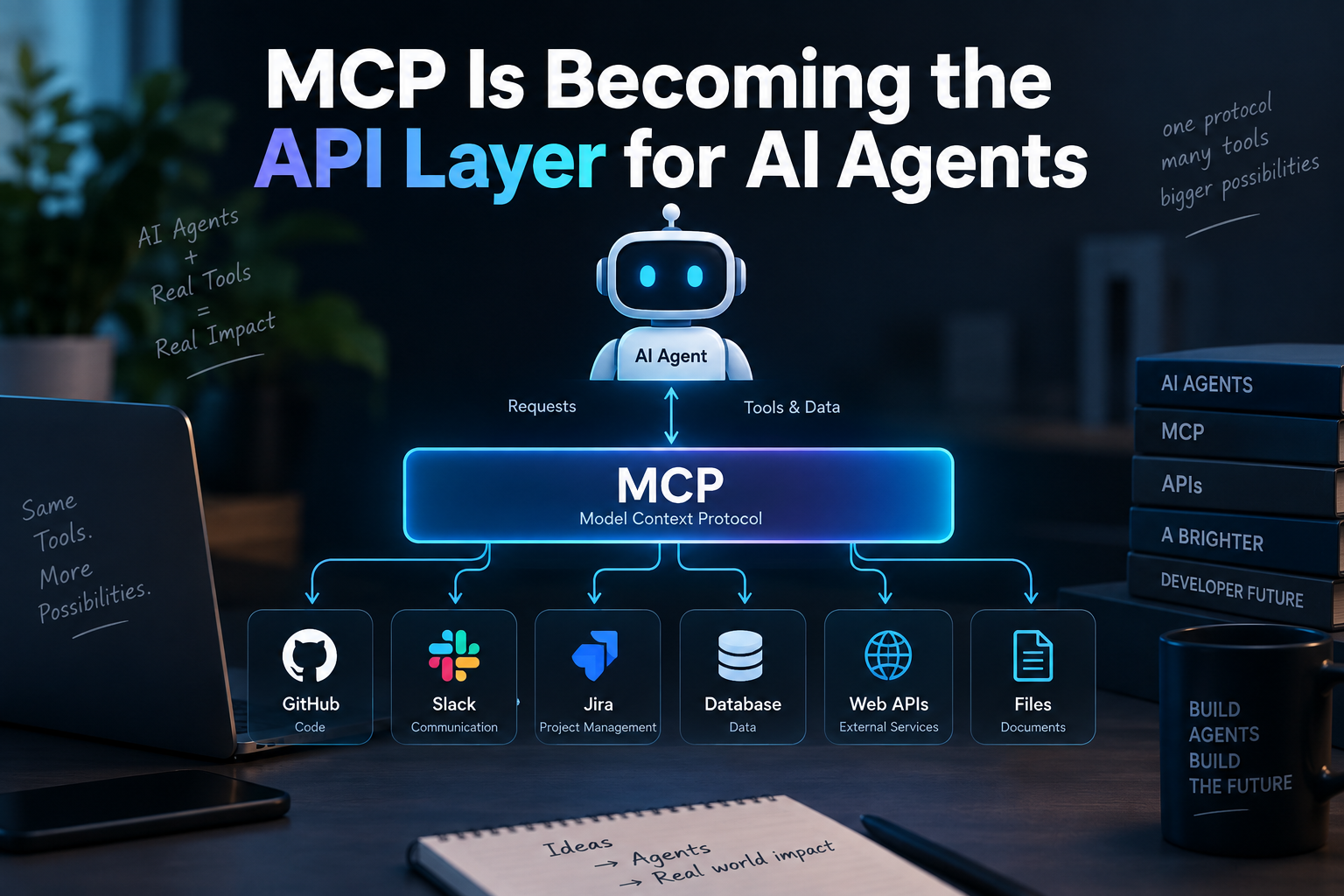
AI agents are changing the way we build software.
A few years ago, most AI applications were simple chatbots. You asked a question, the model generated an answer, and that was it.
Now things are different.
AI agents can search the web, read files, access databases, call APIs, write code, create tickets, and perform tasks on their own.
But this creates a new problem:
How does an AI agent connect to all these different tools?
This is where MCP (Model Context Protocol) becomes interesting.
MCP provides a standard way for AI applications to connect with external tools, data, and services.
And I think MCP could become something similar to an API layer for AI agents.
The Problem With AI Agent Integrations
Imagine you're building an AI coding assistant.
You want your agent to work with:
GitHub
Jira
Slack
PostgreSQL
Internal APIs
Documentation
One approach is to build a separate integration for every service.
It might look something like this:
AI Agent
   │
   ├── GitHub Integration
   ├── Jira Integration
   ├── Slack Integration
   ├── Database Integration
   └── Internal API Integration
This works, but as the number of tools increases, things can become difficult to maintain.
Now imagine having 20 different AI agents.
You could end up building the same GitHub, Jira, and Slack integrations again and again.
This is one of the problems MCP tries to solve.
What Is MCP?
MCP stands for Model Context Protocol.
In simple terms, it provides a common way for AI applications to communicate with external tools and data.
A simple architecture looks like this:
              AI Agent
                  ↓
              MCP Client
                  ↓
              MCP Server
                  ↓
       ┌──────────┼──────────┐
       ↓          ↓          ↓
    GitHub     Database     Slack
The MCP server acts as a bridge between the AI application and the actual service.
For example, an MCP server for GitHub could expose tools such as:
search_code()
get_repository()
create_issue()
create_pull_request()
The actual implementation behind these tools could use the GitHub API.
The agent doesn't need to know all the details of how the GitHub API works.
It can work with the tools exposed by the MCP server.
MCP Doesn't Replace APIs
This is an important point.
You might be thinking:
"We already have REST APIs. Why do we need MCP?"
MCP isn't really trying to replace REST, GraphQL, or other APIs.
APIs are still the foundation of modern applications.
For example:
Application
     ↓
REST API
     ↓
Service
With AI agents, we can add another layer:
AI Agent
     ↓
MCP
     ↓
REST API / Database / Service
The difference is that AI agents often need to discover available capabilities and decide which tool to use.
A traditional application might already know:
POST /create-ticket
An AI agent may instead need to understand:
Available tools:

create_ticket
search_tickets
get_ticket
update_ticket
It can then decide which one makes sense for the task.
Why MCP Is Useful for AI Agents
Let's take a real example.
Imagine you have an AI software engineering agent.
You give it this task:
"Check the payment issue, look at the related GitHub issue, inspect the logs, and create a Jira ticket if the problem is confirmed."
The agent might need to perform several actions:
User
 ↓
AI Agent
 ↓
Search GitHub
 ↓
Read Logs
 ↓
Analyze Problem
 ↓
Create Jira Ticket
 ↓
Return Result
Without a standard tool layer, every one of these integrations needs to be implemented separately.
With MCP, you could have:
                  AI Agent
                     ↓
                    MCP
                     ↓
       ┌─────────────┼─────────────┐
       ↓             ↓             ↓
    GitHub          Logs          Jira
The agent can use different tools through the same protocol.
This becomes more useful as the number of tools grows.
MCP and Tool Discovery
One thing I find interesting about MCP is the idea of discovering capabilities.
An AI agent doesn't always know beforehand which tools are available.
For example, it might connect to an MCP server and discover:
Available Tools:

- search_documents
- get_customer
- create_ticket
- search_orders
The agent can then decide which tool is relevant to the user's request.
This is different from simply hardcoding every possible function inside the application.
It makes the system more flexible.
MCP and Security
There is another problem that becomes important when AI agents start using real systems:
Permissions.
Giving an AI agent access to a tool doesn't mean it should have unlimited access to that tool.
For example, a customer support agent may need permission to:
customer.read
ticket.read
ticket.update
But it probably shouldn't have:
user.delete
payment.refund
database.admin
A safer architecture looks like:
User
 ↓
AI Agent
 ↓
Identity / Permissions
 ↓
MCP
 ↓
Allowed Tools
 ↓
External System
This is something I think developers will have to think about much more as AI agents become more autonomous.
An agent that can only answer questions is one thing.
An agent that can modify your database or deploy code is a completely different security problem.
MCP + A2A
I've previously written about A2A (Agent-to-Agent) communication.
MCP and A2A can be thought of as solving different problems.
A simple way to look at it is:
Agent ↔ Agent
     ↓
    A2A
And:
Agent → Tools / Data
     ↓
    MCP
For example, imagine a system with three agents:
                  Orchestrator
                       │
        ┌──────────────┼──────────────┐
        ↓              ↓              ↓
   Research Agent   Coding Agent   Support Agent
        │              │              │
        ↓              ↓              ↓
       MCP            MCP            MCP
        │              │              │
      Tools          Tools          Tools
The agents could communicate with each other while using MCP to access the tools they need.
This makes MCP particularly interesting for larger agent systems.
Final Thoughts
I don't think MCP will replace APIs.
REST, GraphQL, databases, and existing backend services aren't going anywhere.
But I do think we are going to need a standard way for AI agents to interact with those systems.
It's also about better ways for those models to interact with the software around them.
Maybe APIs connected applications to services.
MCP could become the layer that connects AI agents to those services.
What do you think?
Will MCP become the standard way AI agents connect to tools, or will another protocol eventually take its place?
👋 Connect With Me
If you found this article useful, feel free to connect with me or check out my work:
🌐 Portfolio —💻 GitHub — 💼 LinkedIn
Thanks for reading!
If you’re working on AI agents, cloud engineering, DevOps, or full-stack development, I’d love to connect.


